Showing posts with label Digital SLR Camera. Show all posts

Photography as a Hobby


Photography is one of the hobbies that people can pick up and learn fairly easily. Some people have the impression that there is a trick to taking great pictures. There are some different elements you need to consider in order to both enjoy photography as a hobby, and take great pictures. The fact is, with a little knowledge and some practice, wonderful pictures are a click away. There is nothing more enjoyable than capturing pictures of wonderful moments and images and sharing them with others.
In order to pursue photography as a hobby, you first need to learn some of the techniques and skills associated with it. You need to gather the different materials needed as well. Some suggestions for people who are starting photography as hobby include:


* Familiarize yourself with topics that interest you so that you understand the topic you wish to photograph


* Consider investing in either an automatic focus camera, or a self-focusing SLR camera.


* For people who choose nature as a subject of their photography, it is important to consider the location of the pictures they take. Making sure the sun will not affect the picture in undesired ways, and positioning yourself behind the sun so that the light will create clearer shots is important.


* When you first start taking pictures, you may want to practice by taking pictures around your own home. You may even take great pictures of unplanned or unexpected moments!


* You may wish to use a tripod in order to achieve pictures that are steady, and you can produce great images when you use the right angles! Paying attention to the shape, position, and size of the subject you are photographing is important as well.


* In the absence of sunlight, artificial light may be needed. The camera you are using may have a flash, but sometimes the light from it may not be enough to create a clear image.


There are digital cameras available today that can make even beginning photographers look like a professional. You may want to learn how to get your own photographs printed and framed! There are many online resources you can learn about photography from online, making it easy for anyone to learn. Many photographers enjoy sharing their experience with others, and don't mind answering questions. Observe and appreciate the work other people do in photography. The more you learn about photography, the more you are able to develop your own style. There is a wealth of information on the Internet.


The best way to learn about photography as a hobby is by doing it. Try different things until you have mastered them. Do not be afraid to try new things, or to experiment. Ask other people for their opinions of the work you do, it will help you to improve your hobby. You may consider signing up for a class or seminar on photography. Local colleges and universities often offer these courses. Camera shops also offer instructional classes on occasion.


Basic Photography Equipment
For a person starting a hobby in photography, a good, self-focusing camera is a start to the items you may wish to have. There are some additional items that can help to make the hobby more enjoyable. Photography lessons can help you to understand in greater depth the art of photography, as well as more of the technical details of photography. As you become more involved in photography, things such as a camera with the option to switch between various lenses may become something you choose to get. Lenses of different types may interest you, and the types of lenses you decide to get could depend on your subject matter.


Many photographers have a UV Filter which can protect their lens without causing a noticeable change in the pictures they take. A flash is something else that photographers often have; one that is not built into the camera, but one that allows them to take pictures from around twenty feet away while still getting good detail. A good camera bag is something that is a good idea in order to keep your camera and equipment safe.


With some basic equipment, knowledge, and practice photography can be a very enjoyable hobby. It doesn't need to be expensive, and almost everyone can pursue it. Pictures can be developed at many local stores, and shared with family members, friends, and other people. Photography is an enjoyable art from that allows people to express a great deal through even one picture. The pictures you take can be displayed with pride.
Read more

The Advantage of Digital SLR Cameras

Let's begin with the key advantage of digital SLR cameras: they are fast.
Does this sound familiar?
  • You're attending a big event and want to grab a shot of a fleeting moment
  • For some reason your compact digital camera just won't focus
  • FINALLY it locks the focus and you're ready - you press the button
  • But there's a DELAY - the camera pauses for a second, then it takes the shot
The moment is gone - you've missed it.
If this sounds at all familiar to you (and frustrates you immensely), you'll completely understand why speed is a significant advantage of digital SLR cameras.

Built For Speed

2006-02-16-071
So why are some compact cameras so slow and digital SLRs so fast? It's electronics vs. mechanics.
There's a device called a shutter that sits in front of the digital SLR sensor, blocking it from light.
When you take a photo, the shutter (made up of two curtains) opens and closes.
This is different from a compact camera, where there is no shutter mechanism. In compact cameras, the sensor is electronically activated every time you take a photo.
The advantage of the mechanical solution is that it is instantaneous: you press the shutter button and the shutter snaps open.
There's never a delay when you want to capture that photo of a lifetime.
If this was the only advantage of digital SLR cameras, it might be enough for anyone who's frustrated with a sluggish compact camera.
For anyone who's still skeptical, here are a few others.

A Lens For Every Occasion

I am an indecisive person.
I had an undeclared major in college for months, and spent almost a year after I graduated trying to figure out what to do with my life.
This is why it's no surprise that a digital SLR is the perfect camera for me!
If I want to take landscape photos, I attach a wide-angle lens. If I want to photograph bugs and flowers, I use a macro lens. When I take photos of my labrador, I use a telephoto lens and can snap shots even when I'm halfway across a field.
One camera, tons of lenses.
Sure, you say, but what about all those fancy compact cameras they have now with built-in mega-zooms? I can get one lens that does it all.
Again, it comes down to speed.
Zoom lenses in compact cameras take time to zoom in and out since the zoom is driven by a motor. You manually control the zoom of a digital SLR, and can zoom as fast or slow as you like.

High Quality in Low-Light

One clear advantage of digital SLR cameras is that they're able to capture photos even when there's not a lot of ambient light.
So what? Every camera can take a photo when there's not a lot of light - just turn on the flash.
Here's the trick: digital SLR cameras can do it without the flash.
natural light
Digital SLRs are able to take photos when there's little available light because of a feature called ISO: it makes the digital sensor more sensitive to light.
While several compact digital cameras will also let you change the ISO of the camera, there is one key difference.
As you increase the ISO (and increase the camera's sensitivity to light) you also add grain or "noise" to the image.
The advantage of digital SLR cameras when it comes to ISO is that even at high ISO settings they produce very little noise. I can't say the same about compact cameras.
If you really enjoy taking photos when there's not a lot of light, the image quality of a digital SLR will exceed a compact any day of the week.

You Have Control

This is my favorite advantage of digital SLR cameras.
I don't like a machine to be making decisions for me. While it's right most of the time, it isn't right ALL of the time. The human brain will always be better at judging a scene then a camera set to automatic.
With a digital SLR, you have complete control over every photo you take, and don't have to rely on the camera to make choices for you.
Even if you're not ready to make the jump to a fully manual camera, don't be frightened off.
Every digital SLR camera lets you use an automatic setting, and provides you with intermediate steps that offer increasing levels of control over your images.
Read more

What Is a Digital SLR Camera?

If you've been wondering "what is a digital SLR?" I'm not all that surprised.
Many consumers are much more familiar with compact digital cameras, since these models have flooded the marketplace.
Like cell phones, it's hard to walk down the street these days without seeing someone snapping a photo. Digital SLR cameras are far less common, and up until 2005 were really only used by professionals.
The good news is that the price of digital SLRs keeps falling and many are competitive now with the high-end compact cameras. This also means that many new consumers are hearing about these cameras and aren't quite sure what they can do.
So what is a digital SLR? Let's find out.

SLR Defined

SLR is an abbreviation: it stands for Single Lens Reflex.
Now you know what SLR stands for but that doesn't really help answer the question, does it? Let's define further:
  • With an SLR camera, you see exactly what the lens sees
  • You can change the lens on a digital SLR
  • Digital SLRs have large image sensors that produce high-quality photos
  • An SLR has a near-zero lag time, and is ideal for action photography
Bottom line? Digital SLR cameras are versatile.
You can take photos of everything from sleeping kittens to race cars and you'll never be limited by your camera.
With an SLR in your hands you can rest assured that you'll only miss great photo opportunities because you weren't prepared, not because your camera was too slow.

The Anatomy of a Digital SLR

To properly answer "what is a digital SLR?" you have to understand a bit about the mechanics of an SLR camera.
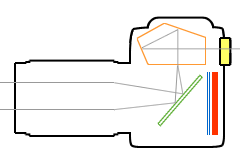
In order to avoid getting overly technical I've simplified this diagram and am highlighting the key elements.
digital slr camera diagram
  1. Light passes through the lens and strikes a mirror (green)
  2. The mirror reflects the light up to a focusing screen
  3. Light passes through the focusing screen and enters a block of glass called a pentaprism (orange)
  4. The pentaprism reflects the image so that you can see it in the viewfinder
  5. When you take a photo, the mirror flips up and a shutter (blue) opens that exposes the digital sensor (red) to light
This is a great example of what-you-see-is-what-you-get. By using the viewfinder you can precisely compose your image and adjust the focus.
Is ithe image that you see in the viewfinder 100% accurate? In most cases it isn't.
If you read digital SLR camera reviews, you may hear a lot about viewfinder "coverage" and "brightness".
Many digital SLR viewfinders only show you 95% of the image that will be captured by the sensor - this is what "coverage" refers to. Unless you are extremely precise when it comes to your photographs you won't notice the 5% difference.
Digital SLR viewfinders also vary in brightness, which is another way of saying how clear the image appears. "Bright" viewfinders make it easier to use manual focus, since you can clearly see the details of your subject.

A Lens For Every Occasion

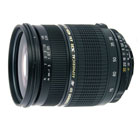
tamron 28-75mm f/2.8
In addition to the pentaprism viewfinder, one of the key features of any digital SLR camera is the ability to change lenses.
Most people think that the camera alone is responsible for capturing an image, but this isn't the case.
The lens that's attached to it can play a huge role in the color, contrast and clarity of every single photo that you take.
Owners of digital SLR cameras can buy lenses that match their photography style, since a landscape photographer should not use the same lens as a wildlife photographer.
The ability to swap lenses at any time adds to the versatility of a digital SLR camera, and means that even if your photography needs change in a couple years, you won't have to buy a new camera, you'll just need a different lens.
Read more

Digital SLR camera buying guide

So what is a digital SLR, anyway?


The term digital SLR is short for digital single lens reflex, so named because these types of cameras use a mirror positioned behind the camera lens to direct light toward the viewfinder when you're composing a photo. When you release the shutter, the mirror swings quickly out of the way, letting light from the lens travel straight to the sensor and momentarily blacking out the viewfinder. The viewfinder in an SLR incorporates a prism--usually a pentaprism--that flips the incoming image around so that you can see it right side up and bounces it onto the focusing screen where you see it.


The SLR design allows one camera to accommodate a very wide range of lens focal lengths, and that's the biggest reason that SLRs dominate serious photography. The explanation? With a non-SLR camera, you have to match the angle of view of the "taking" lens with that of the "viewing" lens. That's easy with a fixed lens or a short-range zoom, but it requires increasingly complex and expensive viewfinder mechanisms as you try to cover a wider range of focal lengths. With an SLR, you avoid this problem because the taking and viewing lens are one and the same.

Most dSLR models beyond entry-level models incorporate a Live View mode, which allows the photographer to use the LCD to compose shots the same way they can with a snapshot camera. The most basic implementations generally lock up the mirror, with the prism diverting the image to a small sensor that feeds through to the LCD rather than to the capture sensor. This does tend to hurt performance, however. Early versions required that you focus manually when in Live View mode, but current models use contrast autofocus.

Types of digital SLRs


Interchangeable-lens full system digital SLR
These are what most people mean when they say "digital SLR," and they are the primary focus of this buying guide. As the name implies, the capability to remove one lens and replace it with another--to go from, say, ultra-wide-angle to supertelephoto--is what sets these cameras apart.


Examples: Almost all of the digital SLRs available today are of this type. Here you'll find reviews of the entry-level, prosumer, andprofessional models that we like best.

Fixed-lens digital SLR
The lenses on these cameras can't be removed, which limits their versatility. The best known of these models use a semitransparent, nonmoving mirror to bounce some light to the viewfinder while letting most through to the sensor, which means you can use their LCDs for composing.


Examples: Olympus E-20N

SLR-like or SLR-style
These are standard digicams that use an electronic viewfinder (EVF)--just a small LCD--in place of an SLR's pentaprism or a point-and-shoot's optical finder. They can't truly be considered SLRs because they have no mirror, and we've yet to see an EVF that approaches the image quality of a decent pentaprism viewfinder. Most cameras of the type have extremely long zoom lenses and cameras are sometimes referred to as ZLRs or megazooms.


Examples: Megazoom

Interchangeable lens cameras
Also referred to as Hybrid cameras, these are models which use the same technology as point-and-shoots, but incorporate an interchangeable lens mount. The first "standard" to emerge in this market is the Olympus/Panasonic Micro Four Thirds joint technology venture. Like SLR-style cameras, they use an EVF, since they lack a mirror for an optical through-the-lens view.


Newbies Photographer Blog, Learning by Sharing
Read more